

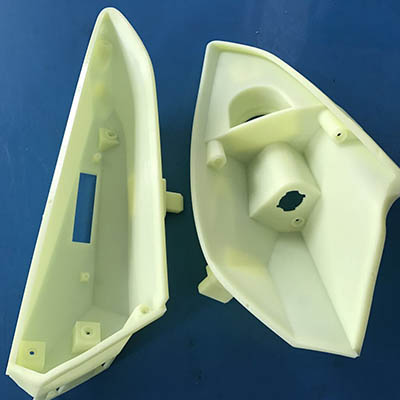
The Relationship between Materials and Processing for Prototype Making
No matter what machines or devices you invent, you all need prototypes to demonstrate the project's feasibility. But how do we manufacture a good prototype? It not only requires a brilliant design but also more concern about the materials and processing technology. The best design, the best materials, the most suitable technology, the most strict inspection process, leads to the best prototype component assembled to the best prototype equipment. So today let us talk about the relationship between materials and processing for prototype making.
Generally speaking, the materials are divided into 2 types: Plastic / Rubber and Metal. The rubber materials are rarely used only in certain circumstances. For example, rubber loop for sealing reinforcement, rubber cushion on chairs, and so on. On the opposite, plastic materials have wide application scope. It has many different sorts. We often divide plastic materials into 2 types: Soft Plastic and Hard Plastic. Soft plastic doesn't mean its hardness is big or small but means it can be recycle used. Of course, hard plastic means it can not be recycle used.
The hard plastic has limited sorts such as PU-Polyurethane, Epoxy Resin, etc. Epoxy resin can be used as the outside protective layer of the CNG-2 cylinder for NGV. The soft plastic has many different sorts such as PP-Polypropylene, PE-Polyethylene, PVC-Polyvinylchloride, PA-Polyamide equal to Nylon, ABS, PEEK-Polyetheretherketone, PTFE, PC-Polycarbonate, etc. Like the PPR pipes we used in house decoration, it is made of PP materials. The stuffing material we used in the diaphragm valve is PTFE. This soft plastic has wide usage in modern industry.
What kind of technology we will adopt to process these plastic materials? it depends on your application, using the environment, and technical requirements. For example, if you only need 1PCS prototype and ABS materials, the color is White. So Vaccum Casting may be most suitable. But if you need 1000PCS, Vaccum Casting will be very expensive. Because casting requires high labor costs and low efficiency. The plastic Injection is suitable for mass production in large quantities. OK. Let us have a look at another example: If you require 1PCS prototype and PP materials, but the size is a little big, CNC will be more suitable.
As for the Metal materials, They can be divided into 4 types: carbon steel / stainless steel / Aluminum / Alloy. (1) Carbon steel is normal material. But considering the using environment, many customers have additional surface treatment requirements such as matt or shiny nickel plating to reinforce the anti-rusting performance. (2) stainless steel is often used in prototype making and OEM manufacturing. There are so many kinds of stainless steel. For example, 304/304L/316/316L/904/A193-B8, etc. 304 and 316 series are mostly used in many industrial fields. Of course, CNC is the most suitable processing technology for these metal materials above. But if you have a special requirement for the surface fineness and dimensional precision, MIM may be applied for this.
(3) Aluminum is also used in prototype making. Among these aluminum materials, AL6061 is widely used especially in the fields of automotive parts and medical equipment. If the customer has no requirement for Aluminum materials, we all recommend AL6061 to them. CNC and Pressure Die Casting can all be used to make it. (4) As for the Alloy materials, it depends on the customer's demand. CNC is also suitable for making it.
The most important thing we need to mention: One kind of material can be processed by several different kinds of technologies. But the making cost may be different. So choosing the most suitable technologies can effectively low down the manufacturing cost.